Play TGC FreeCell Online Free
Master classic FreeCell Solitaire with responsive touch controls, multi-card supermoves, and victory cascades.
Loading game...
About TGC FreeCell
Welcome to TGC FreeCell, our premium digital adaptation of the world's most beloved open-information solitaire challenge. Unlike traditional solitaire where cards remain hidden in mystery stockpiles, FreeCell deals every card face up from move one, making every victory a pure triumph of strategy and foresight.
Here is what makes our version a joy to play:
- One Million Classic Deals: Challenge yourself on any classic deal number from 1 to 1,000,000, including famous historical challenge layouts.
- Fluid Multi-Card Supermoves: Move entire connected sequences smoothly across the board based on your available open cells and empty columns.
- Smart Auto-Move & Hint Engine: Tap the auto-move button to safely advance cards to foundation piles, or get intelligent move guidance whenever you feel stuck.
- Custom Felt Tables & Card Backs: Personalize your table with emerald, navy, midnight, or royal purple card felts alongside custom card back designs.
Whether you want to unwind with a quick game or challenge yourself on a complex high-number deal, TGC FreeCell gives you the ultimate desktop and mobile card table. Clear your cascades, stack your suits from Ace to King, and enjoy that classic victory card bounce!
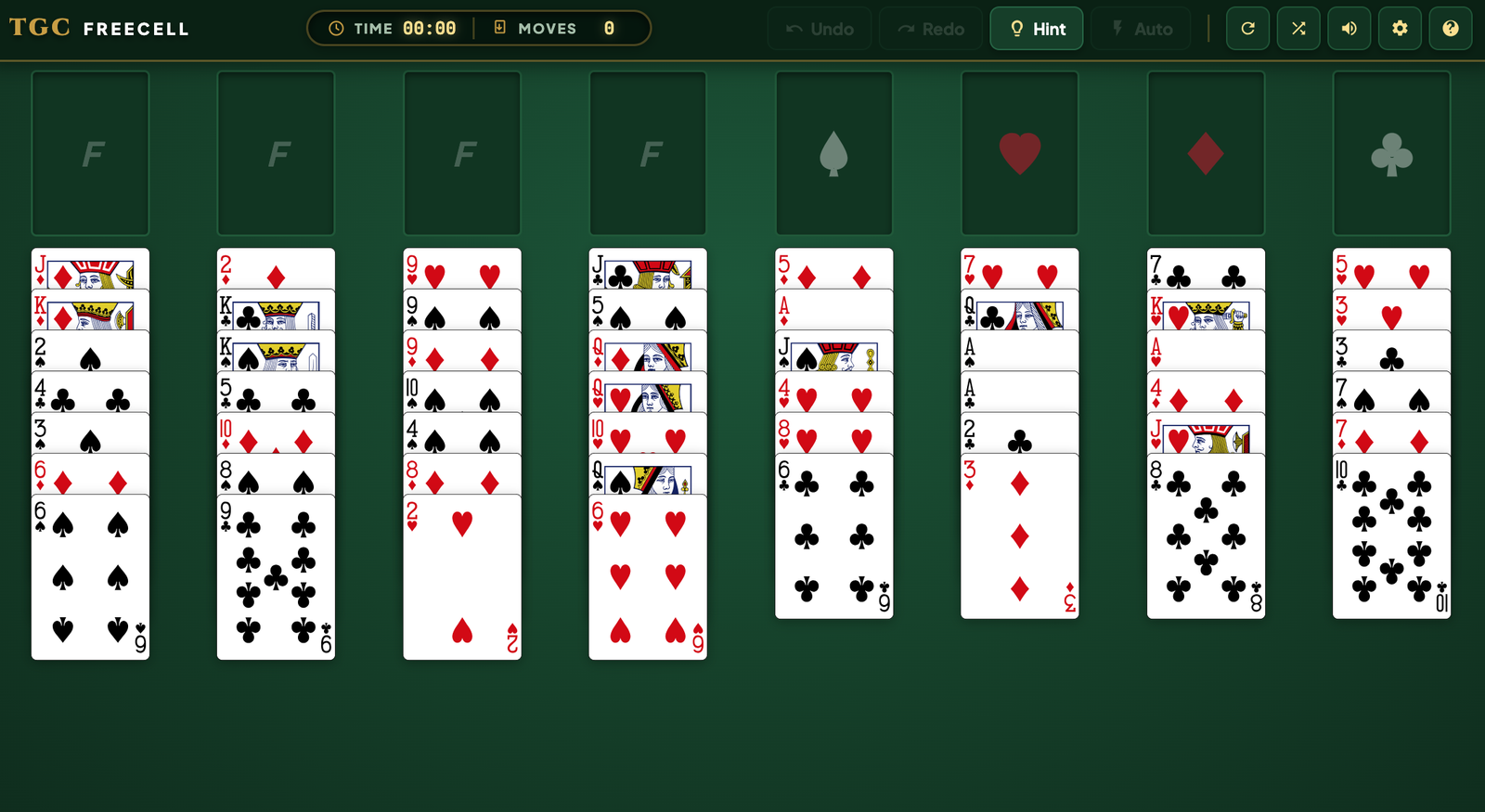
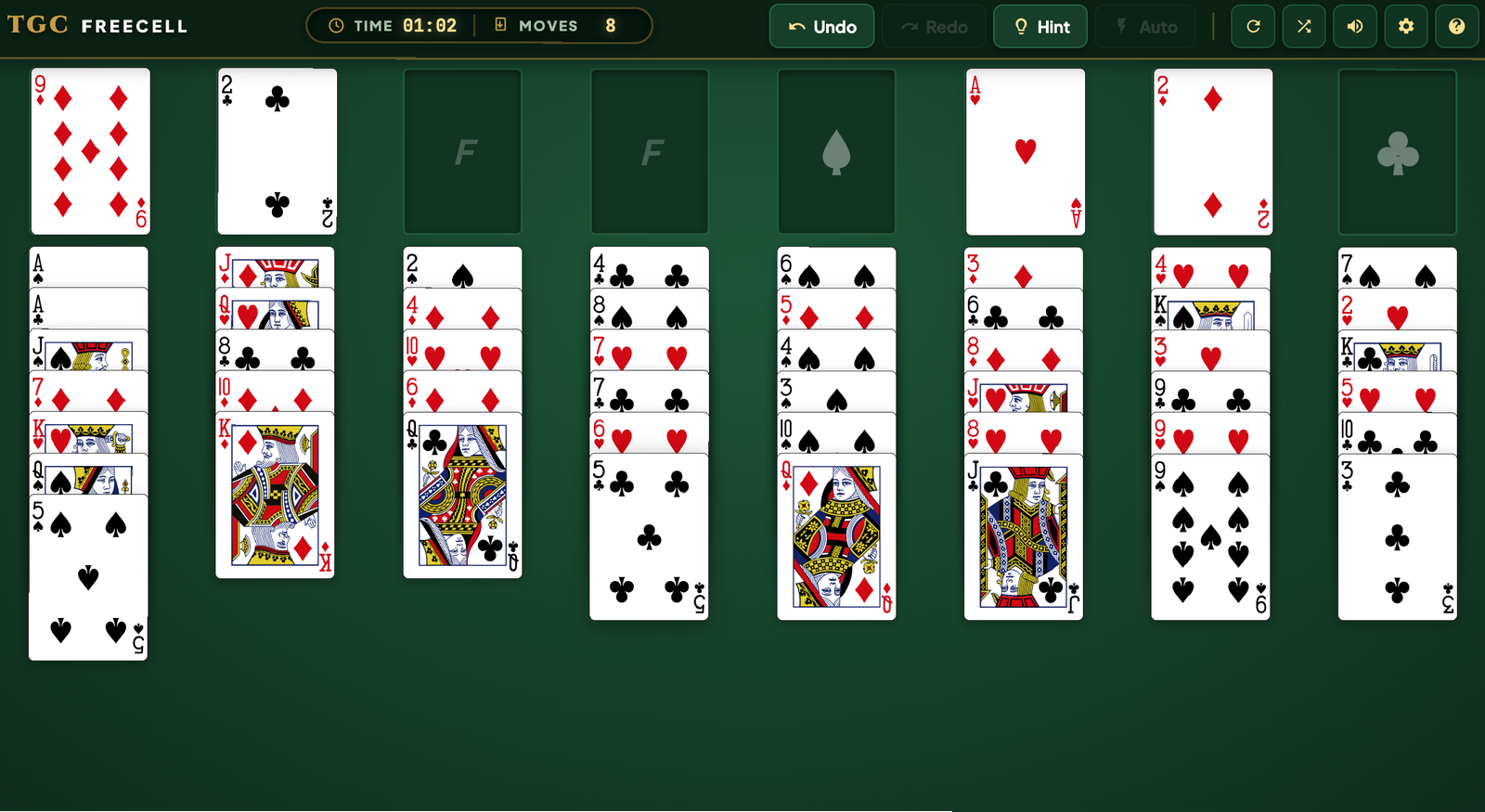
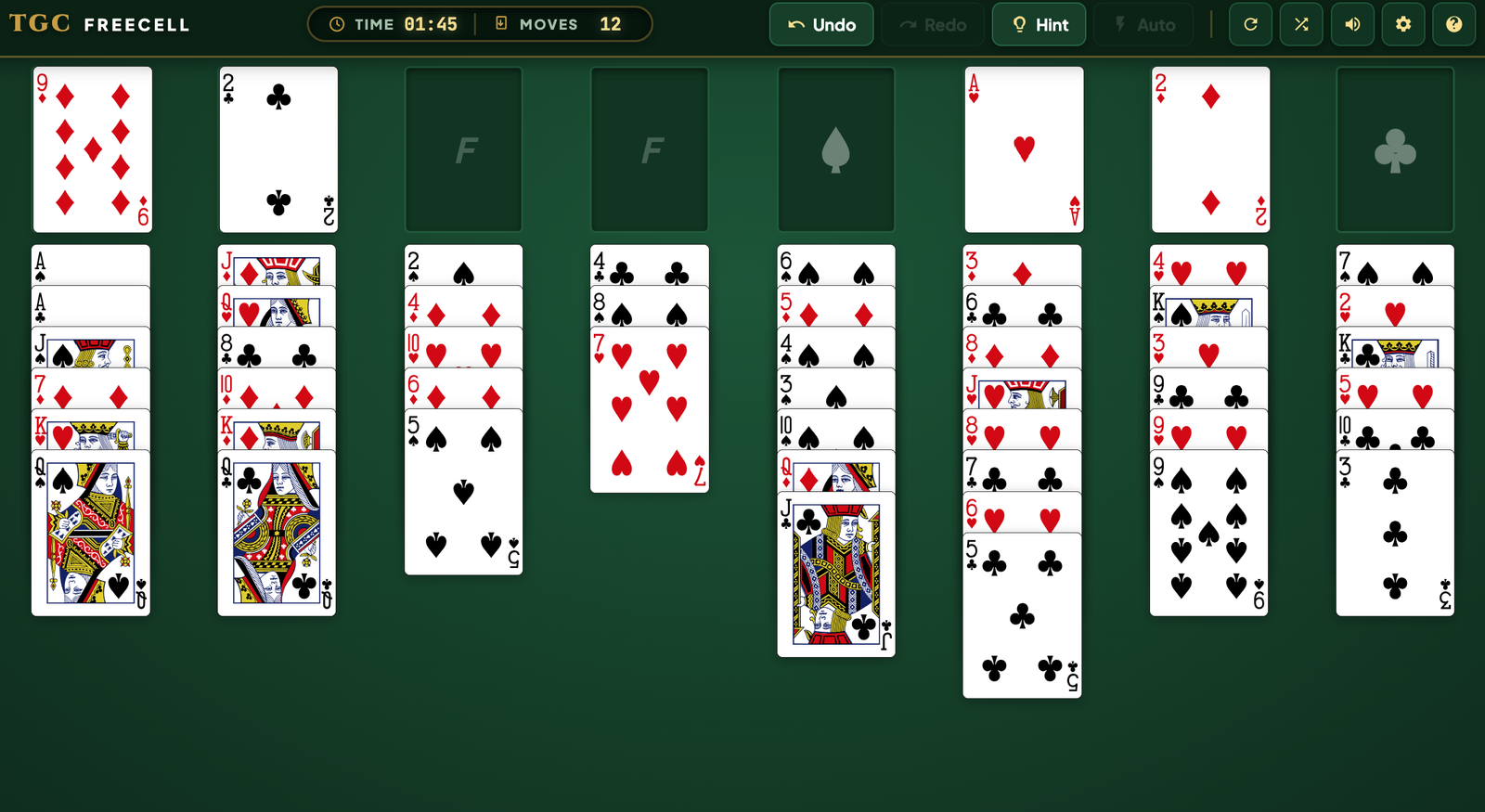
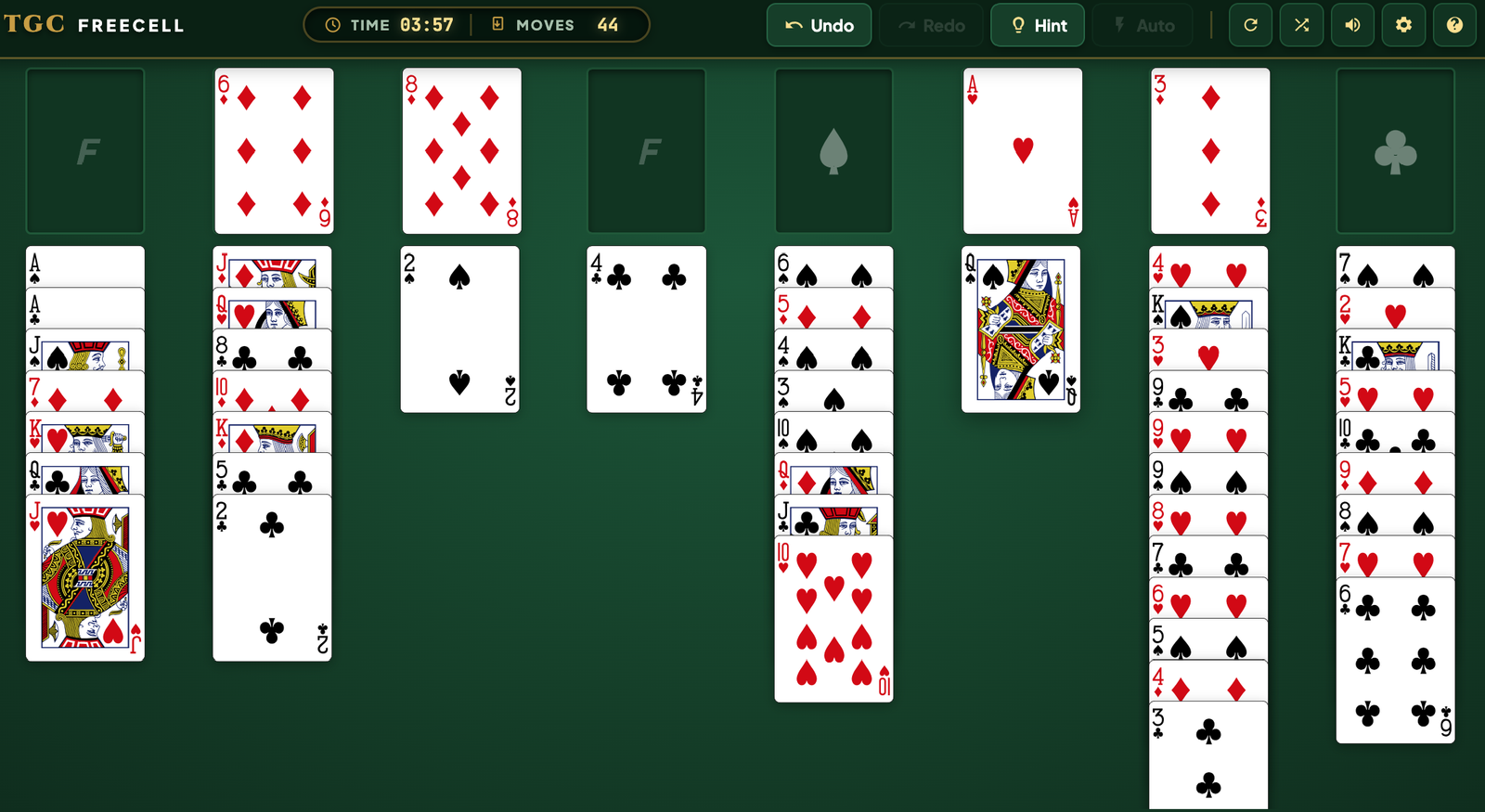
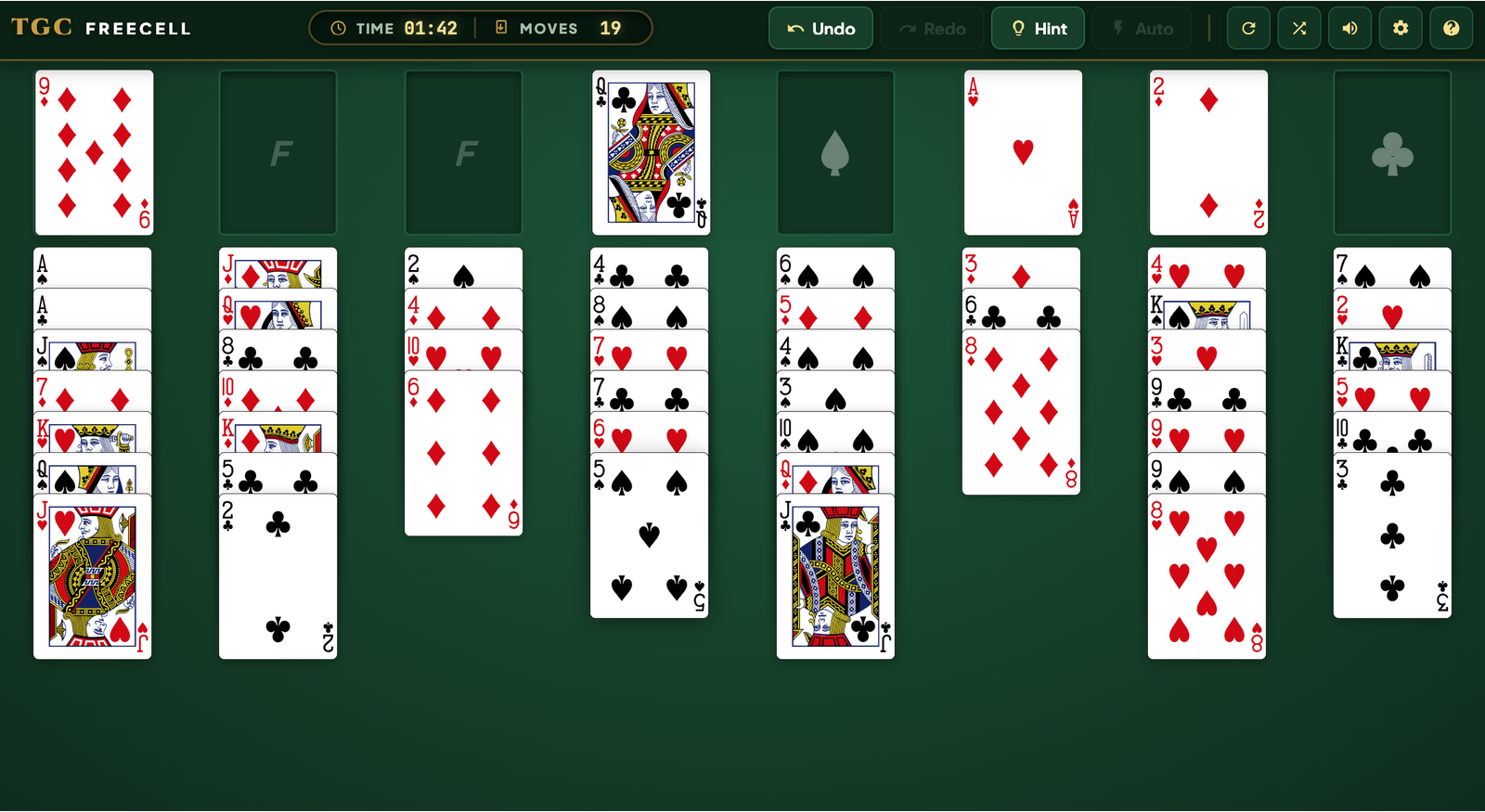
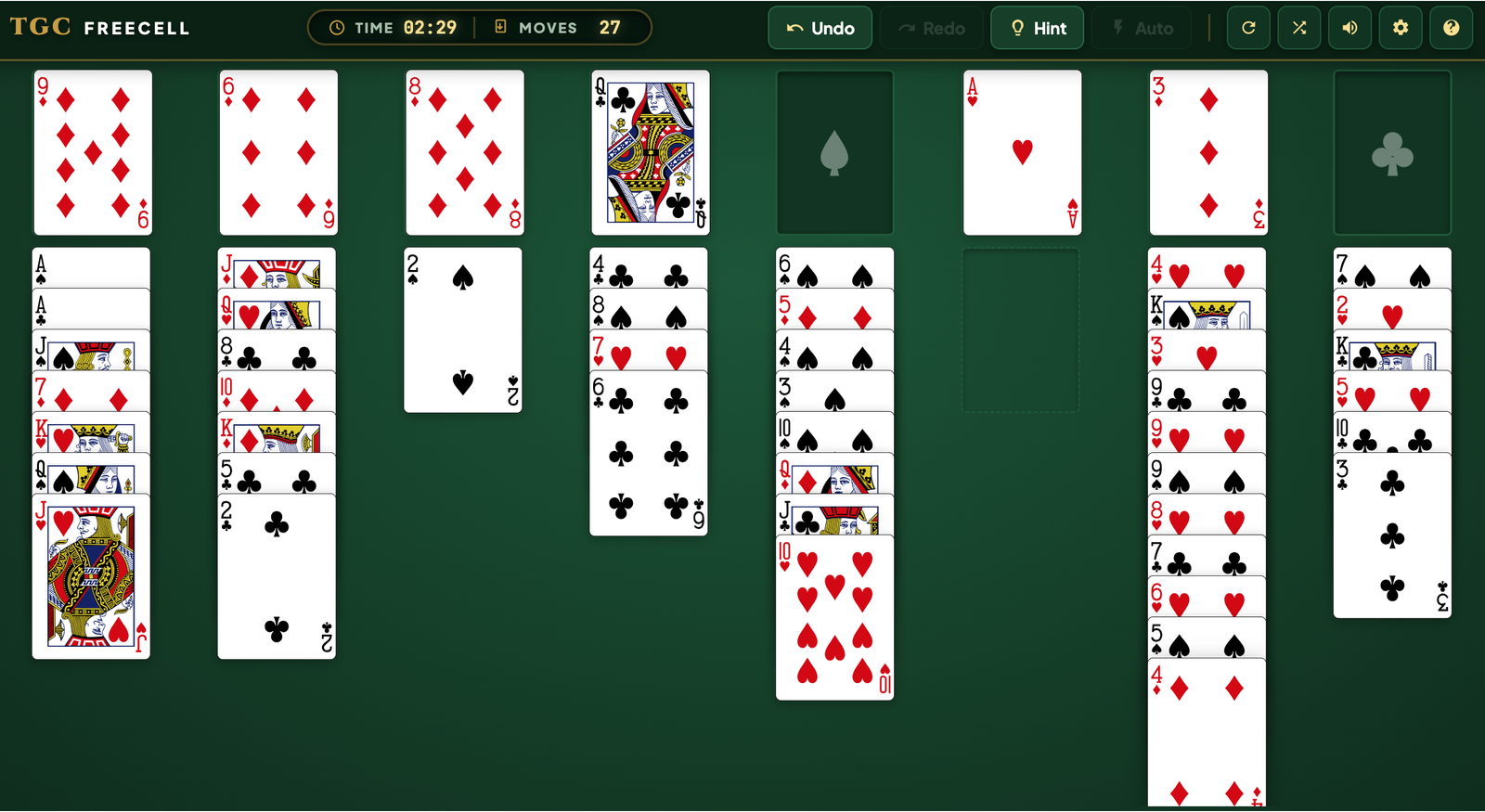
How to Play
Stack Cards in Alternating Colors
Drag cards between columns in descending order (like a red 6 onto a black 7), alternating between red and black suits.
Use the 4 Free Cells for Extra Room
Move a single card into any of the four top-left slots to temporarily get it out of the way and reach cards underneath.
Clear Columns for Extra Stacking
Emptying an entire column gives you an open space where you can place any card or start a new stack with a King.
Build the 4 Foundation Piles from Ace to King
Send Aces to the top-right foundation piles, then stack each suit in order through King to win the game.
Never use a free cell without an exit plan
Only put a card into a free cell if it immediately unlocks a needed card underneath. If you do not know where that card is going next, leave it alone.
Do not waste empty columns on lone cards
Only move a King or high card into a cleared column if you already have the next two or three cards ready to build a real stack on top of it.
Keep mid-rank cards on the board as landing spots
Resist the urge to rush cards like 4s, 5s, or 6s to the foundations too early because you often need them on the table to catch lower cards.
The TGC FreeCell Strategic Handbook
Welcome to the complete player companion for TGC FreeCell, the timeless test of foresight and tactical card maneuverability. Unlike traditional solitaire games that rely on hidden deck luck, FreeCell lays every single card face up right from your opening deal.
This comprehensive handbook breaks down foundational cascade movement rules, column clearing tactics, supermove calculations, and classic deal lore. By mastering how to manage open reserve cells and unblock low cards early, you will consistently turn challenging deals into clean victory cascades.
1. The Pure Skill of Open-Information Solitaire
FreeCell stands apart from other single-player card games because it gives you perfect visibility over the entire board from move one. According to established FreeCell card placement rules, almost every standard numbered deal can be solved with careful forward planning.
The game was first created in 1978 by developer Paul Alfille as a digital evolution of the older Baker's Game format. By allowing players to build descending tableau runs in alternating colors rather than strict suit matching, FreeCell opened up thousands of creative solving pathways.
When Microsoft bundled the game with Windows in the early nineties, it quickly captured the dedication of puzzle solvers worldwide. Dedicated online communities soon proved that across the original thirty-two thousand deals, only deal number 11982 was truly unwinnable.
2. Tableau Organization and Alternating Cascades
The primary playing area consists of eight tableau columns holding all fifty-two cards dealt face up. You can build cards downward in descending numerical order while alternating between red and black suits.
Keeping your cascades orderly makes it far easier to spot deep buried cards that need immediate liberation. Whenever you notice multiple cards in descending alternating rank, you can move them together as a unit if you have sufficient open cells.
Always prioritize unearthing Aces and Twos from the backs of columns during your opening moves. Getting those foundational cards up to the corner piles immediately clears clutter and unlocks easy transfer moves.
3. Managing Free Cells and Empty Columns
The four upper-left free cells serve as your temporary holding stations for single cards when maneuvering around obstacles. Each empty free cell increases the total number of connected cards you can safely shift across the tableau in a single turn.
Try to keep as many free cells empty as possible rather than filling them up right away with high cards. Using up your reserve spaces too early can severely restrict your movement options and lead to unavoidable deadlocks.
Empty tableau columns are even more valuable than individual free cells because you can place an entire alternate sequence into them. Clearing an entire vertical lane gives you tremendous flexibility to rebuild long organized suits from Kings down to Twos.
4. Calculating Supermoves and Multi-Card Transfers
In digital FreeCell, the supermove mechanic automatically shifts long card sequences without forcing you to move each card one by one. The maximum number of cards you can transfer at once equals your open free cells plus one, multiplied by two for each empty column.
For example, having three open free cells and one empty column lets you shift a complete run of eight alternating cards in a single drag. Memorizing this basic formula helps you quickly assess whether a large cascade relocation is mathematically possible.
If you find yourself one cell short of a needed supermove, look for a quick safe foundation transfer to free up extra room. Small incremental maneuvers frequently create the breathing room required to execute game-winning sequence transfers.
5. Tactical Maneuvers and Solving Playbook
Moving Card Stacks
You can move groups of cards together as long as you have enough open spaces. If you want to move a longer stack, free up extra empty spots first.
Clearing Whole Columns
Try to empty out an entire column as fast as you can. Having an open column lets you start fresh stacks with Kings and doubles how many cards you can move.
Holding Back Foundation Cards
Do not rush to send cards to the top right if you still need them to stack lower cards underneath. Keep useful cards on the board until both matching opposite-color cards are already put away.
Saving Empty Free Cells
Treat your four free cells like emergency parking spots rather than permanent storage. Filling them up too early traps your cards and can leave you stuck with no moves.
Digging Out Aces and Twos
Look at where your Aces and Twos are hiding before you make your first move. Getting these low cards to the foundations early gets your piles moving and clears clutter.
Unstacking to Grab Trapped Cards
You can temporarily spread a built stack across your open spaces to grab a card hidden underneath. Once you grab the card you need, quickly put your stack back together on another column.