Play TGC Chess Online Free
Master classic chess tactics, tournament time controls, and adaptive AI engines in a clean modern board studio.
Loading game...
About TGC Chess
Welcome to TGC Chess, a clean and modern chess studio made for casual thinkers and tactical enthusiasts alike. Experience the timeless depth of the royal game with full tournament rules, smart AI difficulty scaling, and flexible clock presets.
Every match puts you in total control of your board style and practice session:
- Adaptive AI Bot: Practice your opening theory and calculation against friendly beginner, intermediate, and master difficulty settings.
- Flexible Clock Controls: Play at your own pace with unlimited casual time, or test your speed in 3-minute blitz, 5-minute rapid, and 10-minute tournament matches.
- Themes and Move History: Switch between tournament green, warm walnut, and modern slate boards while reviewing your full algebraic move history.
- FEN and PGN Tools: Set up custom practice positions or export your completed games for post-match study.
Whether you are learning how the pieces move or sharpening your tactical combinations, TGC Chess gives you a distraction-free space to enjoy the game. Pick your color, set your timer, and make your opening move!
How to Play
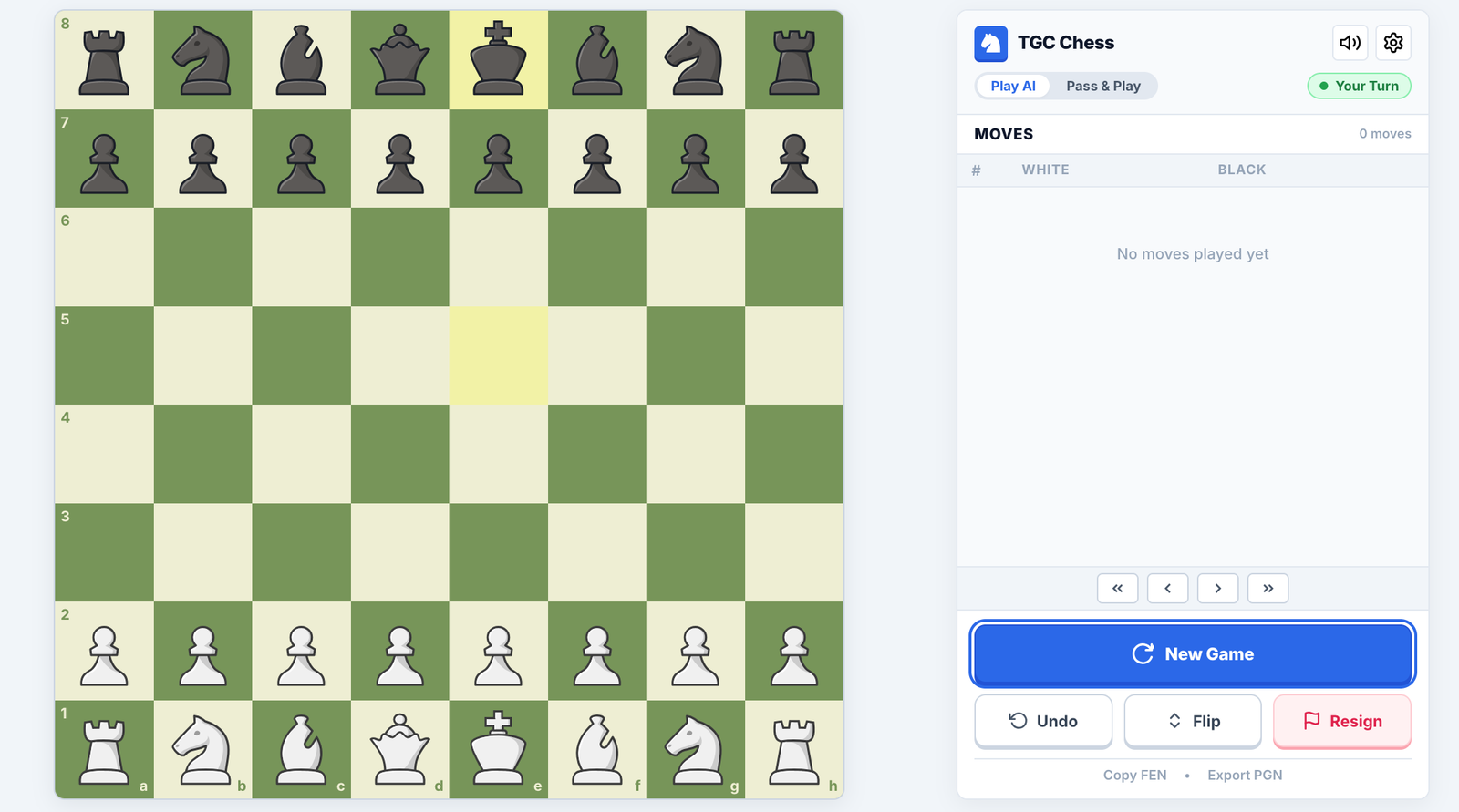
Select Mode & Clock
Choose Play AI or Pass & Play mode, and configure your preferred time control from the match settings menu.
Develop Your Army
Click or drag pieces forward to control the four central squares and establish solid defensive structures.
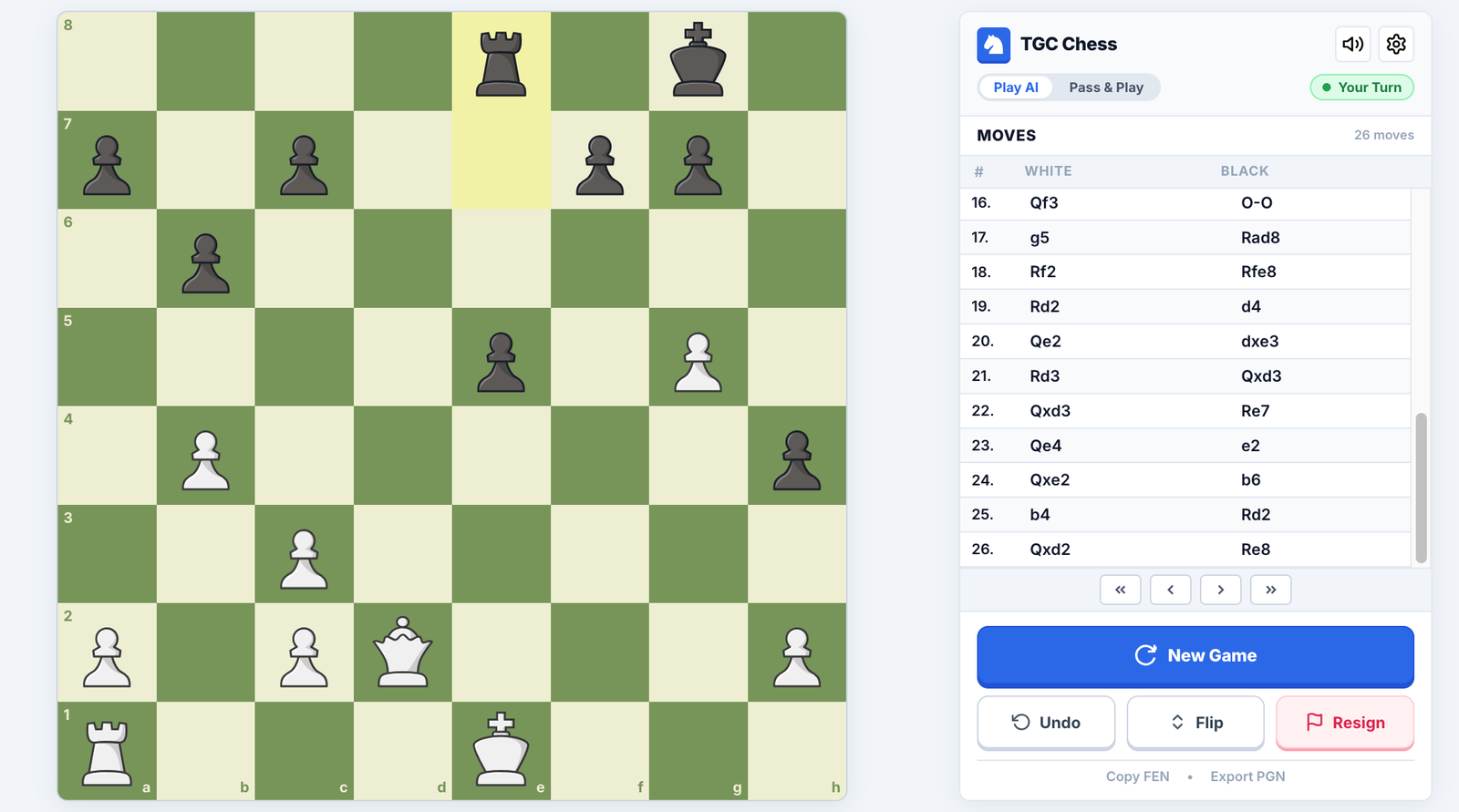
Execute Tactical Combinations
Deploy forks, pins, and skewers to win enemy material, and castle your king early for maximum safety.
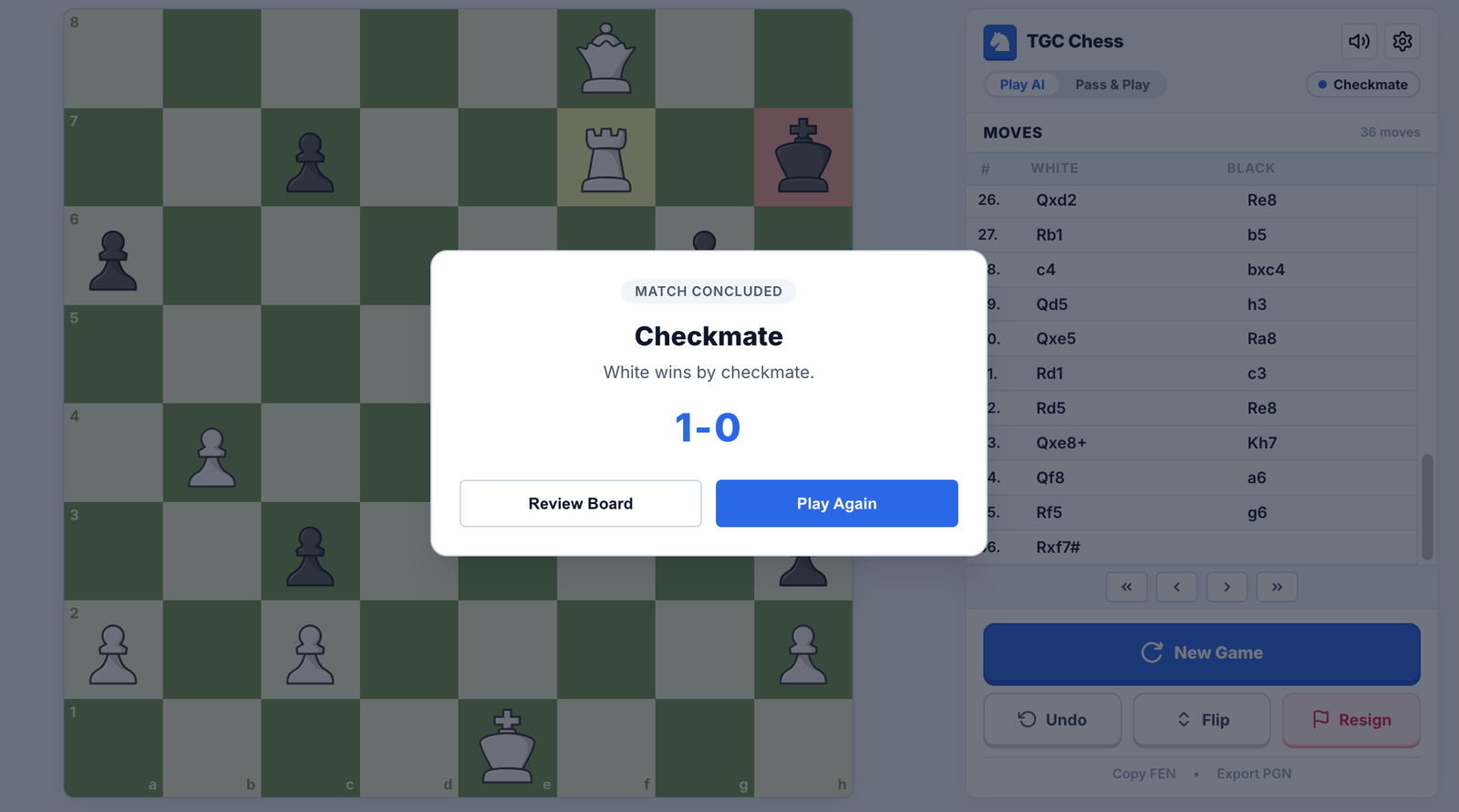
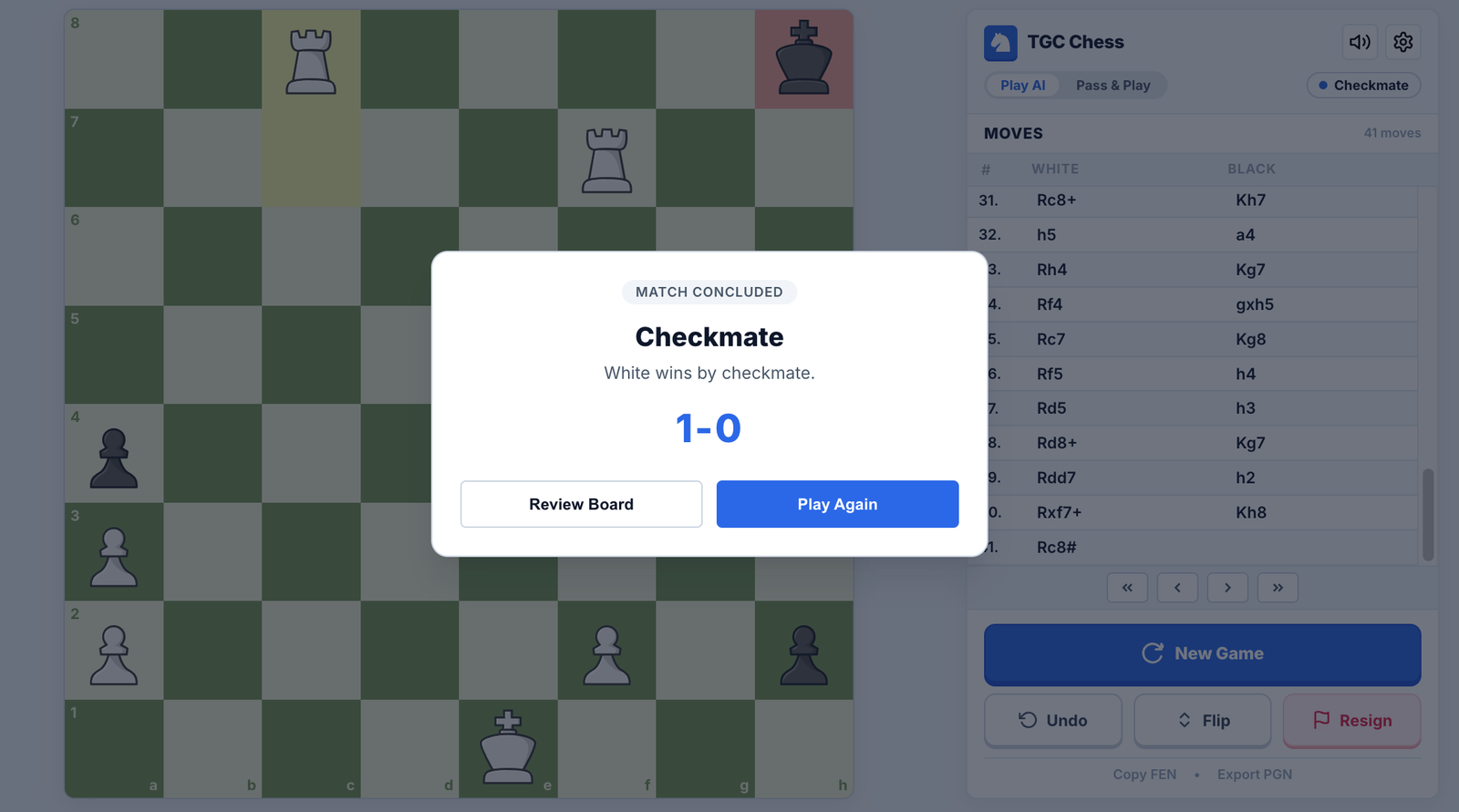
Deliver Checkmate
Coordinate your major pieces and active endgame king to corner the opposing monarch and deliver checkmate.
Control the four central squares
Establishing central pawns and knights gives your pieces greater range and mobility across both flanks.
Castle early for king safety
Tucking your king behind a solid wall of pawns prevents early diagonal attacks and activates your corner rooks.
Do not bring the Queen out too early
Developing minor pieces like knights and bishops first prevents your queen from being chased by enemy pawns.
TGC Chess Master Strategy Handbook
Welcome to the TGC Chess strategy handbook, your friendly companion for mastering the royal game. Whether you are learning your first opening moves or sharpening tactics against our smart AI, this guide will help you play with confidence.
1. Origins and Global Heritage of Chess
Chess has brought thinkers together for over 1500 years, beginning as an ancient Indian strategy game called Chaturanga. That original game mirrored real-world warfare with four distinct units: infantry, cavalry, mighty war elephants, and chariots.
As travelers carried the game across Persia and into Europe, players added exciting new rules that made matches faster and more creative. Major European updates in the late 15th century turned the Queen and Bishop into long-range powerhouses, giving us the thrilling modern game we enjoy today.
Official international standards came together in 1924 when passionate organizers founded FIDE in Paris. Brilliant thinkers like Alan Turing designed early chess algorithms to explore artificial intelligence, paving the way for the digital engines we play with today.
Modern web chess makes it easier than ever to practice tricky positions and test new ideas against adaptive computer opponents. Grab a seat, pick your favorite board style, and enjoy exploring this timeless masterpiece of strategy.
2. Board Geometry and Piece Mobility
Your match unfolds on a classic 64-square grid made up of alternating light and dark squares across 8 ranks and 8 files. You start each game with an army of 16 pieces, giving you plenty of creative ways to plan your attack and defend your home squares.
Rooks glide straight along open files and ranks to control long corridors, while bishops zoom diagonally across squares matching their starting color. Knights are unique jumpers that hop over other pieces in an L-shaped path, making them wonderful for surprising crowded defenses.
Queens combine the straight-line speed of a rook with the diagonal sweep of a bishop, making them your most versatile attacking powerhouse. Pawns march forward one step at a time, capture diagonally, and have the special option to leap forward two squares on their very first move.
Your king only steps one square in any direction, so keeping him safe behind a shield of friendly pieces is always your top priority. Whenever an opponent threatens your king with check, you must react right away by moving him to safety, blocking the line, or capturing the attacker.
3. Tactical Principles and Opening Control
Controlling the four center squares right from move one gives your pieces room to breathe and strike across both sides of the board. Bringing your knights and bishops into the action early sets up active attacking lanes while keeping your position solid.
Castling early is one of the smartest habits you can build because it tucks your king into a safe corner while waking up your rook. Rushing into an attack with just one or two pieces rarely works, so make sure your whole team is developed before you push forward.
A fork lets a single piece threaten two enemy targets at the same time, forcing your rival into a tough defensive choice. Pins are just as deadly because they trap an enemy piece in place when moving it would expose a more valuable piece behind it.
Keeping your pawns connected in clean diagonal chains prevents weak spots that your opponent could target later in the game. Look for clever sacrifices that break open the enemy king's shelter and turn a quiet position into a winning breakthrough.
4. Master Endgames and King Tactics
Once most pieces are traded off, your king transforms from a quiet royal in hiding into your most valuable attacking helper. Marching your king toward the center allows you to guide your pawns forward and shut down enemy counterplay.
The concept of opposition happens when two kings face each other with just one square between them in a tactical standoff. Holding the opposition forces your opponent to step aside, opening up a clear runway for your pawns to advance.
Passed pawns that have no opposing pawns in front of them are pure gold in the endgame. Marching a passed pawn all the way to the 8th rank lets you promote it to a brand new queen and wrap up the game quickly.
Take your time calculating pawn races and king paths so you do not accidentally trigger a stalemate draw when you are ahead. Staying patient in simplified endgames is the mark of a true chess master.
5. Key Terminology and Definitions
A clever maneuver where a single piece attacks two or more enemy targets at the exact same moment. Knights and pawns make incredible forkers because they can strike high-value targets without risking equal trade.
A straight-line attack that paralyzes an enemy piece because moving it would expose an even more important piece behind it. Absolute pins freeze a defender completely because stepping away would put their own king in illegal check.
A unique pawn rule that lets you capture an enemy pawn that just leaped two squares forward past your waiting pawn. You must make this special capture immediately on the very next turn as if the enemy pawn had only moved one square.
A special two-piece move where your king slides two squares toward a corner rook while the rook hops right beside him. This move protects your king behind a wall of pawns and instantly brings your rook into the center of the action.
A fascinating German chess term for a situation where any legal move a player makes will immediately damage their position. It is especially decisive in tight endgames where passing your turn is not allowed.
The ultimate winning moment in chess where the enemy king is under direct attack with zero legal ways to escape. Delivering checkmate wins the match immediately no matter how many pieces your opponent has left on the board.