Play Ludo Online Free
Roll dice, navigate tokens around the track, and strike rival pieces.
Loading game...
About Ludo
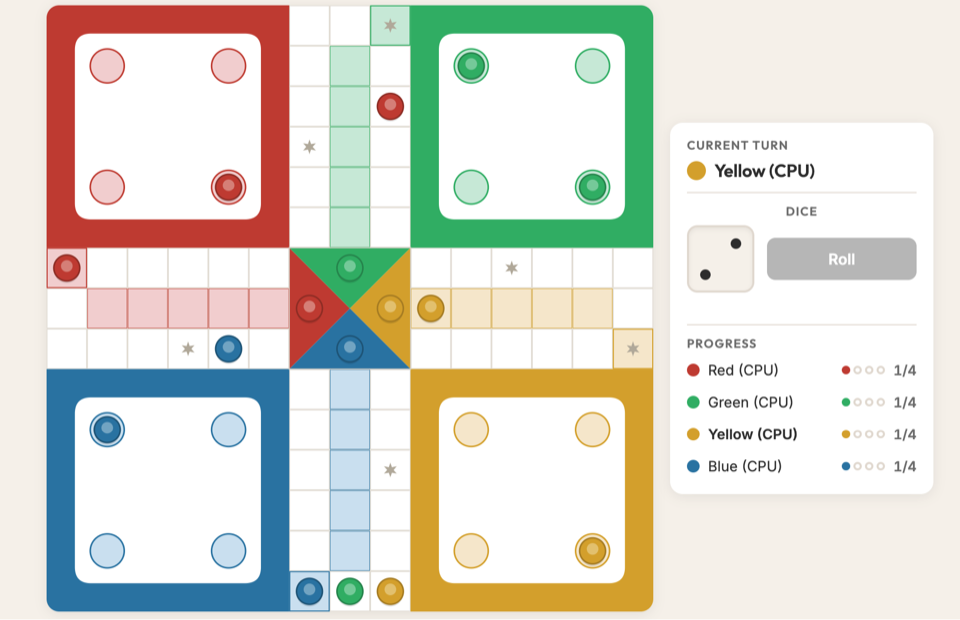
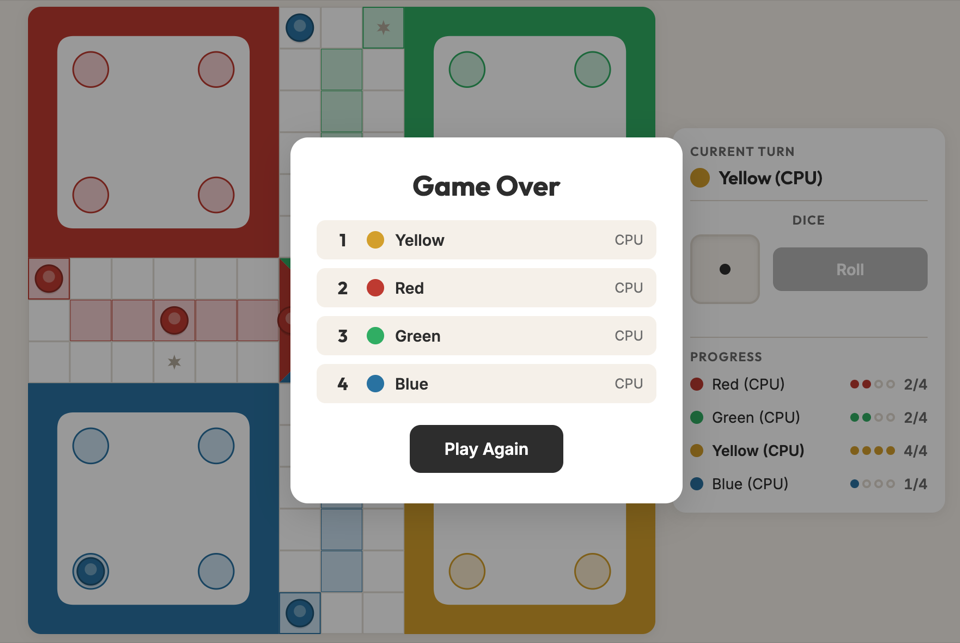
Welcome to Ludo, one of the most beloved board games in history. This faithful digital recreation brings the full Ludo experience to your browser with smooth canvas rendering, animated token movement, and responsive controls. Race your four tokens around the board, navigate the home stretch, and be the first player to bring every piece safely home.
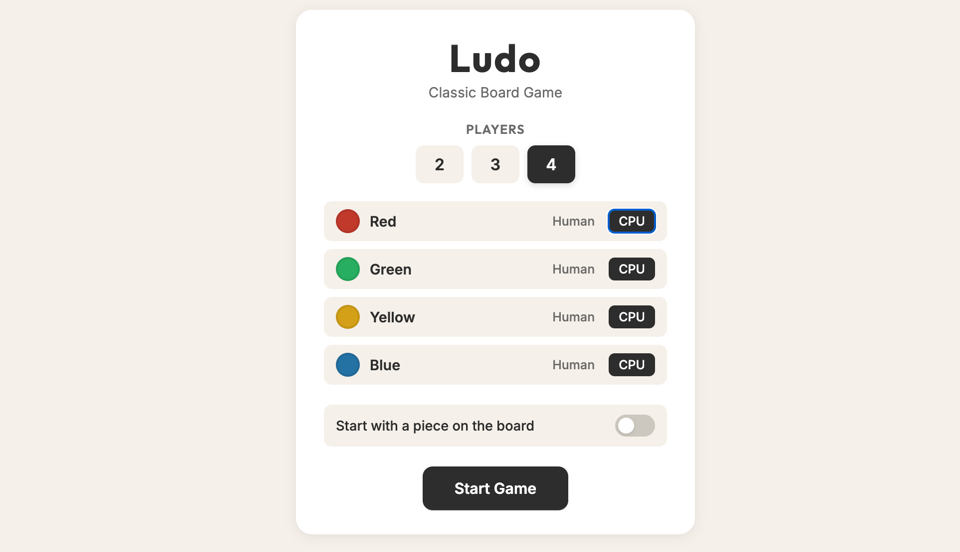
Choose between 2, 3, or 4 players and assign each seat to a human or CPU opponent. The AI evaluates every move by weighing captures, safe square positioning, and home column advancement to provide a genuine challenge at every turn. Toggle Quick Start mode to begin with one token already on the board for faster games.
The classic rules are fully implemented with faithful accuracy:
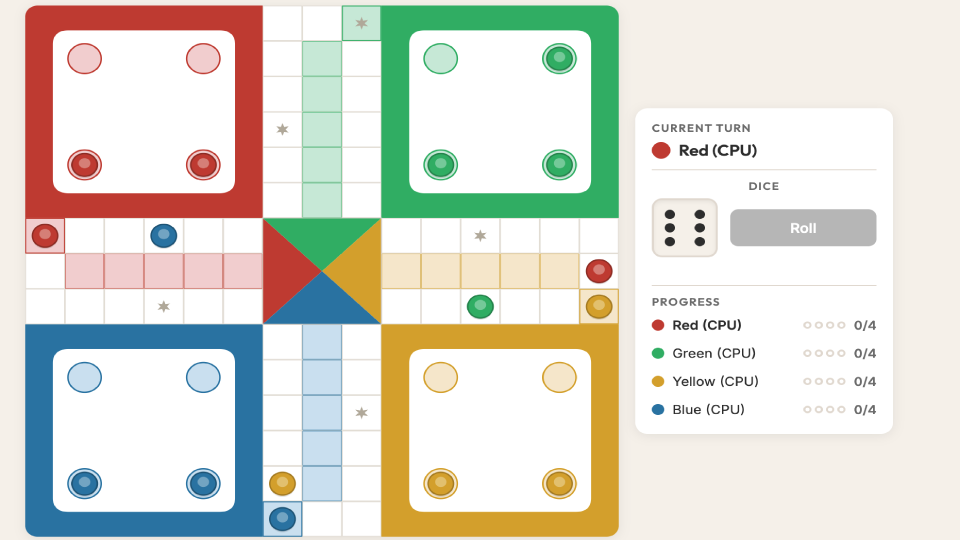
- Yard Exit: Roll a 6 to move a token from your colored yard onto the starting square of the shared track.
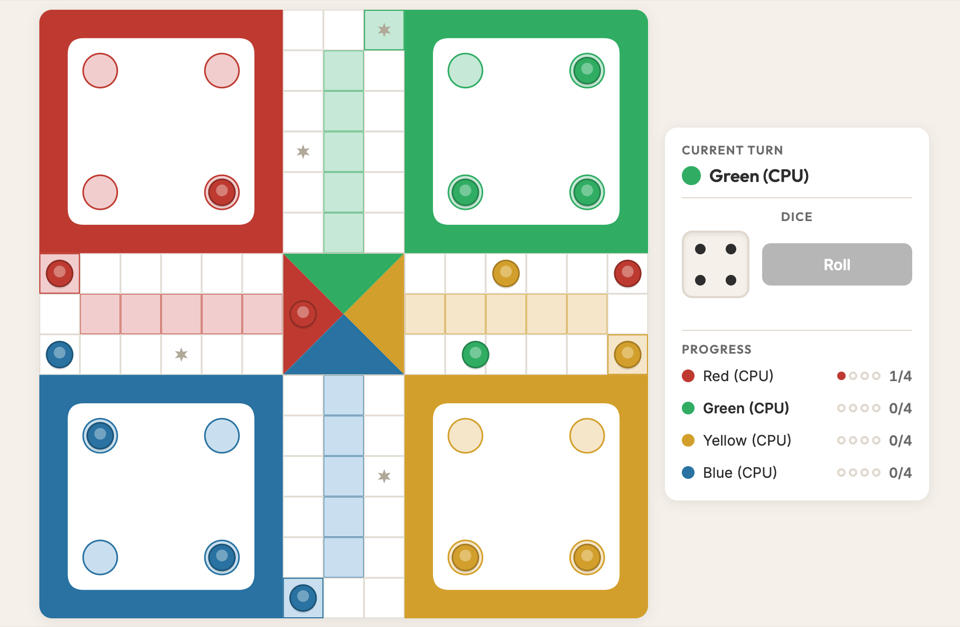
- Captures: Land on an opponent's token to send it back to their yard, unless it sits on one of eight protected safe squares.
- Extra Turns: Rolling a 6 grants a bonus roll, but three consecutive sixes forfeit your turn entirely.
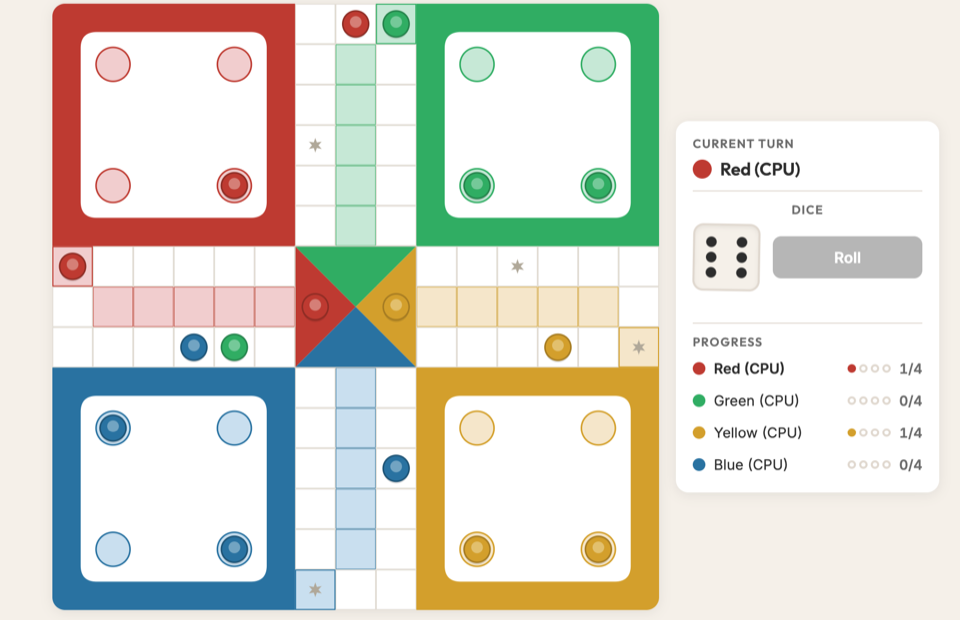
- Exact Landing: Tokens must land on the final home cell by exact count. Overshooting is not allowed.
How to Play
Choose Players and Mode
Select 2, 3, or 4 players and set each seat to Human or CPU. Toggle Quick Start to begin with one token already on the board.
Roll and Exit the Yard
Click the Roll button to throw the dice. You must roll a 6 to move a token from your colored yard onto your starting square.
Move and Capture
After rolling, select a highlighted token to advance it clockwise along the 52-cell track. Landing on an opponent's token sends it back to their yard, unless it sits on a protected safe square.
Race Home to Win
Once a token completes the full loop, it enters your colored home column. Land on the final cell by exact count to bring it home. Get all four tokens home first to win!
Prioritize exits on a six
Getting tokens out of the yard early gives you more options and reduces your risk of being stuck with no valid moves.
Use safe squares defensively
Park vulnerable tokens on star squares and start squares where they cannot be captured, especially when opponents are close behind.
Balance aggression and speed
Chasing captures is tempting, but advancing your lead token toward the home column often wins more games than hunting opponents.
Origins and Global Evolution of Ludo
Ludo stands as one of the most enduring board games in human history, tracing its lineage directly back to ancient India. This comprehensive handbook explores the rich heritage, mathematical probabilities, tactical mechanics, and foundational terminology of the game.
From Ancient Pachisi to Modern Tabletop
The historical ancestor of Ludo is Pachisi, a traditional Indian cross-and-circle race game played for over fifteen centuries. Historical records show that Mughal emperors played human-scale games on outdoor marble courtyards using court members as live playing pieces.
In the late nineteenth century, the traditional game was adapted and patented in England under the commercial name Ludo. Discover who invented Ludo and how it became popular in this detailed historical study. The Western adaptation simplified the movement rules and replaced traditional cowrie shells with a standard six-sided die.
Worldwide Variants and Cultural Spread
As the simplified rules gained international popularity, different cultures developed their own distinct adaptations of the classic cross-and-circle format. In the United States, Parcheesi became a household favorite, while Germany embraced Mensch argere Dich nicht with enthusiasm.
Despite minor differences in board design and safety zones, the fundamental racing objective remains consistent across all international editions. Players navigate four tokens around a shared track toward a central home square while managing risk and blocking rivals.
Board Geometry and Movement Physics
Understanding the structural coordinates of the Ludo board provides players with a strong analytical foundation for decision making. Every cell on the grid serves a specific operational role during the race.
The 52-Cell Shared Track
The main circuit consists of fifty-two white squares arranged in a cross layout surrounding four colored yard corners. Each player starts from a unique entrance square and travels clockwise around the entire perimeter of the board.
Because all tokens share the same outer track, congestion naturally develops near track intersections and starting areas. Navigating these high-density sectors requires careful calculations to avoid landing within striking range of incoming opponents.
Protected Safe Squares and Home Stretch
The board contains eight designated safe squares, consisting of the four colored starting positions and four star-marked spaces. Tokens standing on safe squares cannot be captured by opposing pieces regardless of dice outcomes.
After completing a full revolution around the track, a token turns into its designated home column consisting of five colored cells. This home corridor leads directly into the central triangle where tokens reach their final destination by exact roll.
Tactical Principles and Risk Management
While dice rolls introduce an element of chance, strategic piece management determines long-term win rates. Master these core principles to maximize your control over the board.
Yard Release and Token Activation
Rolling a six is required to move a token out of the yard and place it on the starting square. Players should generally prioritize activating new tokens whenever a six is rolled to expand their available movement options.
Having multiple active tokens on the board allows you to distribute move distances efficiently and avoid forcing vulnerable pieces into danger. A single active token is easily targeted, whereas a balanced spread of tokens provides strategic flexibility.
Capture Strategies and Defensive Positioning
Capturing an opponent token sends it back to their yard and grants you an immediate bonus roll. Always calculate whether an aggressive capture exposes your own token to a counter-attack on the following turn.
When leading the race, position your tokens on safe star squares to block opponents behind you without risking capture. Defense is often more valuable than aggressive hunting when your primary objective is securing a fast home arrival.
Managing Consecutive Sixes and Exact Finishes
Rolling a six awards an extra turn, but rolling three consecutive sixes forfeits the turn and voids the third move. Track your streak carefully so you do not build plans around risky multi-six sequences.
As your tokens enter the home column, calculate exact distance requirements to avoid overshooting the center. Leaving tokens stacked in the home stretch can bottleneck your movement when small rolls are required.
Ludo Terminology and Definitions
Familiarize yourself with the essential technical vocabulary used by experienced players and digital board game implementations.
The colored corner area of the board where a player's four tokens reside at the start of the game. Tokens remain in the yard until a six is rolled to release them onto the track.
A marked cell on the track where tokens are completely immune to capture by opponents. Safe squares include starting positions and designated star squares along the circuit.
The action of landing exactly on a cell occupied by an opponent's token on a non-safe square. Capturing forces the opponent token back to its yard and awards an extra turn.
The exclusive five-cell colored corridor leading from the track into a player's central home triangle. Opponents cannot enter another player's home column under any circumstances.
The requirement that a token must reach the final home triangle on an exact dice count. Overshooting the central cell renders the move invalid and forces the player to select another token.
The penalty rule that immediately cancels a player's turn if they roll three consecutive sixes. While single and double sixes award bonus rolls, the third consecutive six voids the move and passes initiative.