Play Dots and Boxes Online Free
Connect grid points, complete squares, and outmaneuver your opponent.
Loading game...
About Dots and Boxes
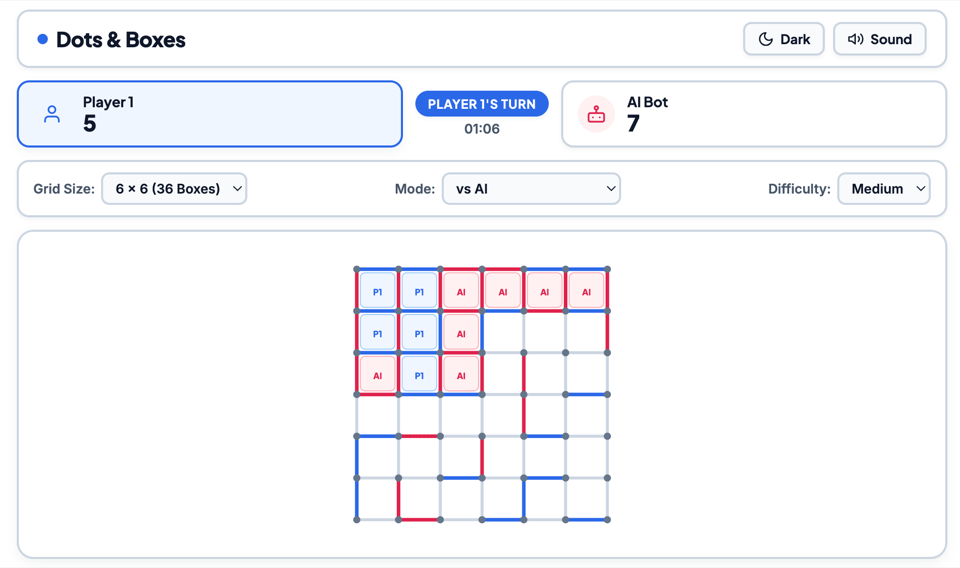
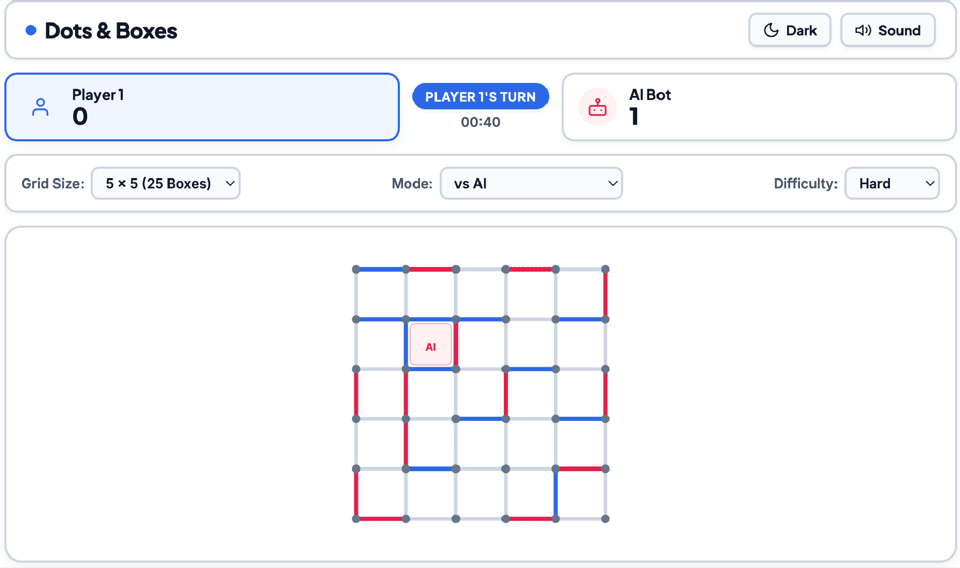
Welcome to Dots and Boxes, the ultimate pen-and-paper strategy game brought to life in smooth digital interactive format. Your goal is to connect adjacent dots with lines to complete 1x1 grid squares and claim the majority of the board. Completing a box scores a point and immediately grants you an extra turn, opening up strategic chain reactions across the grid.
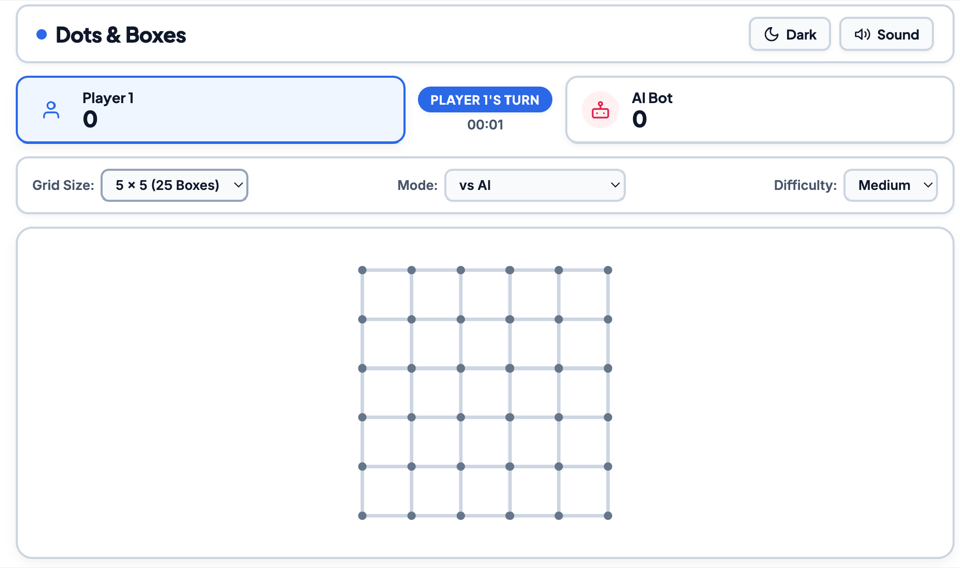
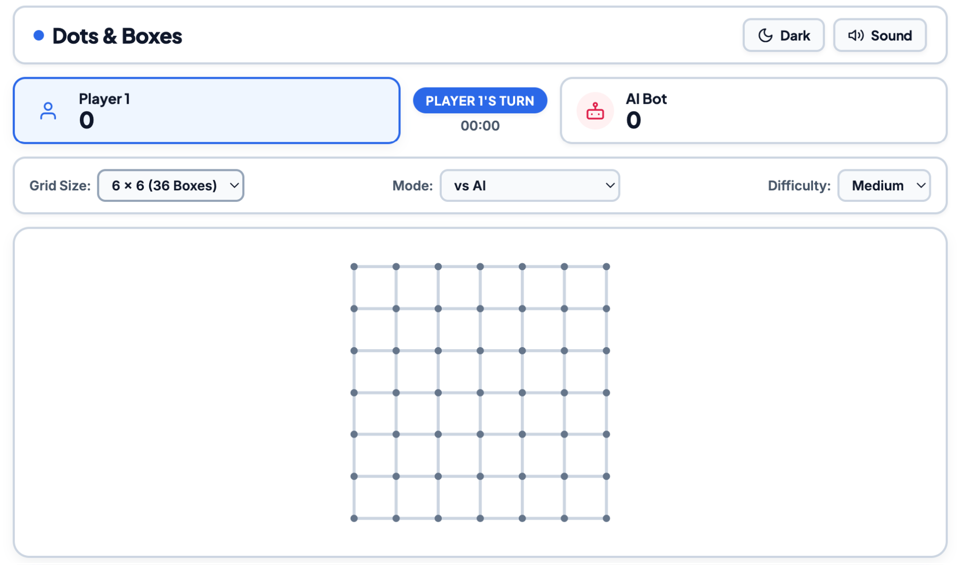
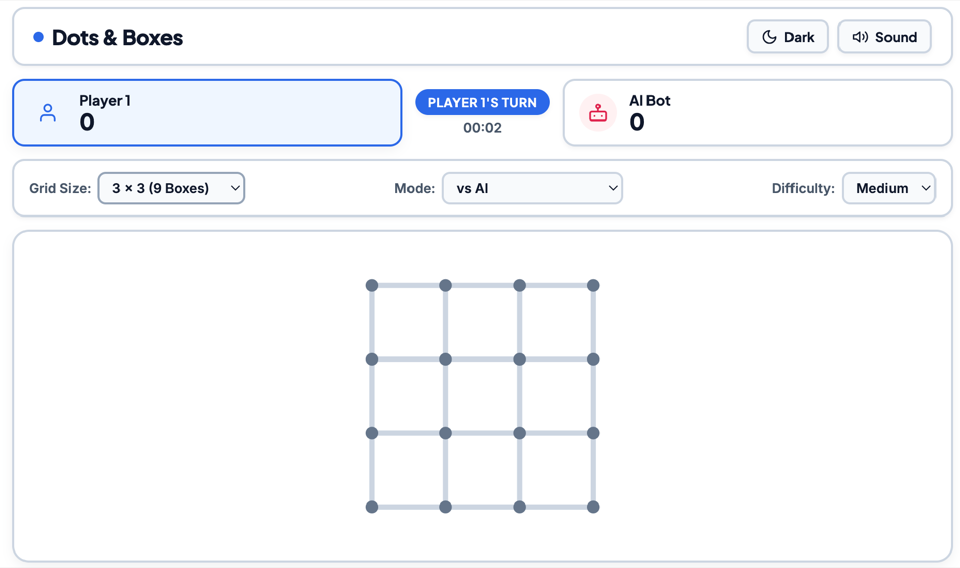
Play against our adaptive AI Bot across Easy, Medium, and Hard difficulties, or challenge a friend in 2-Player Pass and Play mode. Customize grid dimensions from compact 3x3 boards up to challenging 6x6 battlefields to test your tactical control and double-cross strategies!

How to Play
Select Grid and Mode
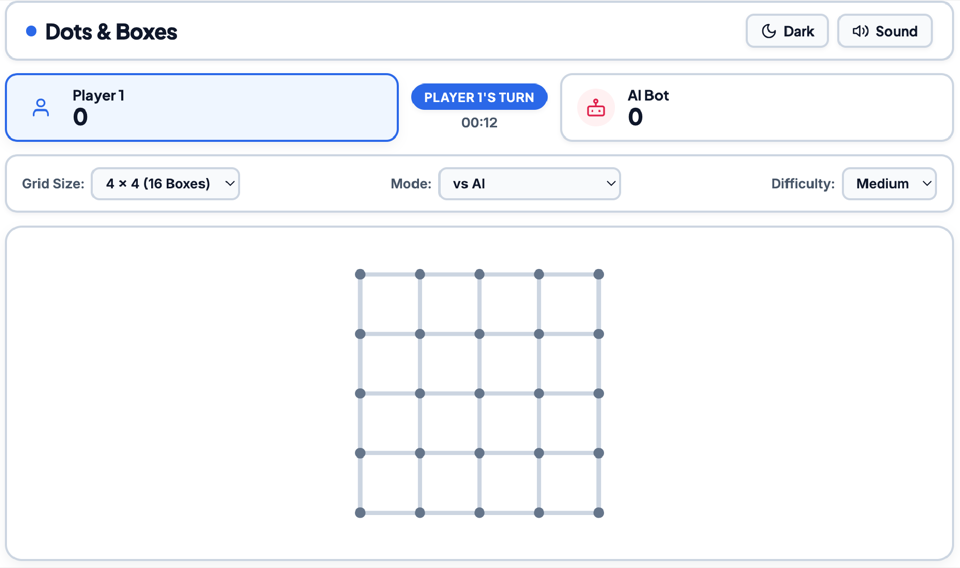
Choose your preferred grid size (3x3 to 6x6), set the game mode (vs AI or 2-Player Pass & Play), and select AI difficulty.
Draw Grid Lines
Click or tap the space between any two adjacent dots to draw a horizontal or vertical line segment.
Complete Boxes for Points
When you draw the fourth enclosing line of a box, it fills with your color, scores 1 point, and grants an extra turn.
Claim Most Boxes to Win
Continue taking turns until all lines are drawn and every box is claimed. The player with the highest box count wins!
Avoid creating 3-sided boxes
Do not draw the third line of a box early, as it gives your opponent an easy box capture.
Master the double-cross
Sacrifice two boxes at the end of a long chain to force your opponent to open the next big chain.
Count chain lengths
In the midgame, open the shortest chains first to minimize your opponent's points when safe moves run out.
Dots and Boxes Master Strategy Handbook
Welcome to the definitive strategic manual for Dots and Boxes on The Game Cove. Master grid control, chain management, and double-cross tactics to dominate your matches against both human opponents and advanced AI.
1. Origins, History & Mathematical Foundations
Dots and Boxes was first published in 1889 by French mathematician Édouard Lucas under its original title La Pipopipette. Over the following century, the game evolved from a popular European parlor pastime into one of the foundational subjects of modern combinatorial game theory.
Lucas was renowned for creating iconic mathematical recreations, including the Tower of Hanoi and extensive prime number tests. His work demonstrated how elementary recreational games frequently encapsulate profound principles of discrete mathematics and structural graph theory.
Mathematicians quickly recognized that despite its accessible pen-and-paper presentation, the game possessed enormous strategic depth. Analysis reveals that the total number of distinct grid states grows exponentially as board dimensions expand from simple three-by-three grids to larger competitive layouts.
Unlike traditional chance-based table games, Dots and Boxes is a deterministic game of perfect information with no hidden elements. Every drawn segment alters the topological structure of the remaining board, creating a dynamic puzzle where players actively shape the arena of conflict.
Early mathematical studies laid the groundwork for identifying optimal move selections during both the opening phase and the late endgame. Modern computational solvers have since proved that specific grid sizes favor either the first or second player under flawless execution.
As computer science advanced, the game became a standard testbed for evaluating graph theory algorithms and tree-search mechanics. Today, studying its mathematical principles provides valuable insights into spatial logic and zero-sum game mechanics.
2. Grid Geometry & Board Topography Principles
Understanding the physical layout of the grid is essential for developing a sound positional strategy across all board sizes. Segments attached to corner dots touch fewer total squares than interior lines, making perimeter areas structurally distinct during early play.
Drawing lines along the outer edges of the grid creates fewer immediate threats while gradually developing board architecture. Players who focus their early attention on securing safe perimeter boundary lines build a solid foundation without exposing vulnerable territory.
Corner segments are particularly valuable opening choices because they only border a single box on the entire grid. Securing these outer boundaries minimizes early risks and establishes clean structural anchors across the board.
Interior grid intersections present greater tactical complexity because each interior segment touches two adjacent boxes simultaneously. Placing lines carelessly near the center can prematurely create three-sided traps across multiple connected squares.
As grid dimensions scale up to six-by-six boards, regional control becomes a vital consideration during midgame maneuvers. Dividing the overall board into semi-isolated territorial zones enables players to contain opponent advances and manage local line density effectively.
Recognizing how different grid sizes alter line availability is key to pacing your early moves accurately. Smaller grids require immediate tactical precision, whereas larger boards allow for extended positional maneuvering before forced sacrifices occur.
3. Chain Management & Turn Initiative Mathematics
A chain is defined as a contiguous sequence of open boxes that can be captured sequentially in a single turn. The player who controls the opening of long chains almost always secures enough total points to win the match.
When safe moves are completely exhausted, a player is forced to draw a line that creates a three-sided box for their opponent. A skilled player will carefully select which chain to open, choosing the shortest available option to minimize opponent scoring opportunities.
Short chains consisting of only two or three boxes should always be offered to your opponent before exposing major long chains. This minimizes the initial point damage while preserving your strategic flexibility for subsequent board turns.
Chain parity refers to the total number of long chains present on the board during the decisive transition phase. Calculating whether the count of long chains is even or odd enables players to predict who will hold turn initiative when the final chain is breached.
Maintaining turn initiative allows a player to dictate the tempo of capture sequences while forcing their rival into defensive responses. Strategic line placement in midgame ensures that your opponent is forced to break open major scoring opportunities first.
Counting the total boxes contained within each potential chain allows you to formulate precise endgame plans. Evaluating these sequence lengths in advance ensures that every forced move works to your ultimate scoring advantage.
4. Advanced Sacrificial Tactics & Double-Cross Mastery
The double-cross maneuver is the single most important advanced technique in competitive Dots and Boxes play. This tactic involves deliberately forfeiting the last two boxes of a chain to maintain turn control rather than capturing every available square.
By leaving two unclaimed boxes at the end of a chain, you force your opponent to take those two points on their turn. Because they made the final capture in that section, they must now draw the next line, opening the next long chain for you to sweep.
Executing a successful double-cross changes the entire momentum of a match by turning a single capture into a dominant streak. Opponents who are unfamiliar with this technique often fall into traps that cost them dozens of total boxes.
When managing closed loop structures of four connected boxes, a modified double-cross requires forfeiting four boxes instead of two. Executing this expanded sacrifice ensures that you retain overall board control when dealing with circular chain formations.
Calculating the net point trade-off is critical before attempting any sacrificial double-cross maneuver near the end of a match. Giving up two or four points is only advantageous if the subsequent chain you receive contains a higher total point yield.
Mastering the double-cross separates casual players from tournament-level strategists across all competitive formats. Consistently applying this technique turns seemingly disadvantageous board states into decisive end-game victories.
5. Key Game Concepts & Terminology
A sequence of interconnected boxes that can all be claimed in a single continuous turn once opened. Controlling when a chain is breached determines who claims the majority of the grid.
A sacrificial tactic where a player deliberately forfeits the last two boxes of a chain to retain turn control. This forces the opponent to open the next long chain on the board.
A grid line segment that does not create a third side on any adjacent box. Drawing safe edges early builds the grid framework without giving away box completions.
A box with three drawn sides that offers an immediate point to whoever fills the final fourth line. Leaving traps prematurely gives your opponent instant box captures.
A closed ring of connected boxes that can be claimed continuously without giving up turn initiative. Loops require specialized double-cross maneuvers to manage efficiently.
The mathematical reduction of Dots and Boxes grid positions into equivalent graph theory values. Understanding these values helps determine winning line placements in complex endgames.