Play Checkers Online Free
Jump enemy pieces, crown your kings, and dominate the tactical board.
Loading game...
About Checkers
Welcome to Checkers, one of the world's most famous traditional board games. This digital edition delivers standard American and English Draughts on an eight-by-eight grid featuring smooth drag-and-drop movement, crisp piece animations, and realistic sound synthesis. Play against intelligent AI opponents across multiple difficulty levels or challenge a friend in local pass-and-play mode.
Each player begins with twelve pieces positioned on the dark squares of their respective side of the board. Red moves first, advancing pieces diagonally forward one square at a time onto empty dark spaces. When an opposing piece occupies an adjacent diagonal square with an open cell behind it, you must jump over the opponent piece to capture it and remove it from the board.
The classic rules are enforced with faithful accuracy:
- Forced Captures: When a jump capture is available, players must execute the jump. Multiple consecutive jumps in a single turn must be completed if available.
- King Promotion: Reaching the farthest row crowns your piece into a King, granting the ability to move and capture both forward and backward.
- Victory Condition: Win the game by capturing all twelve enemy pieces or trapping your opponent so they have no legal moves remaining.
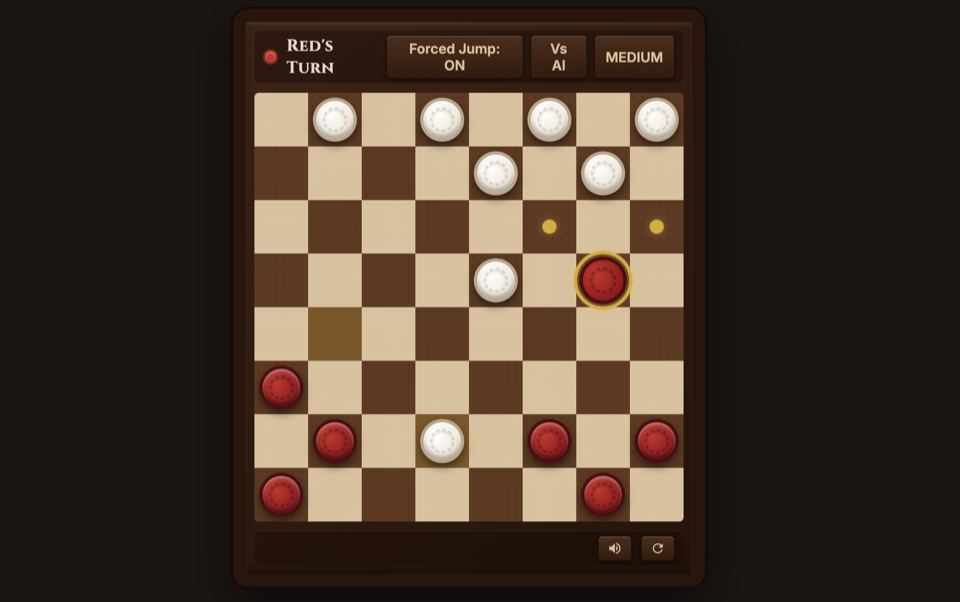
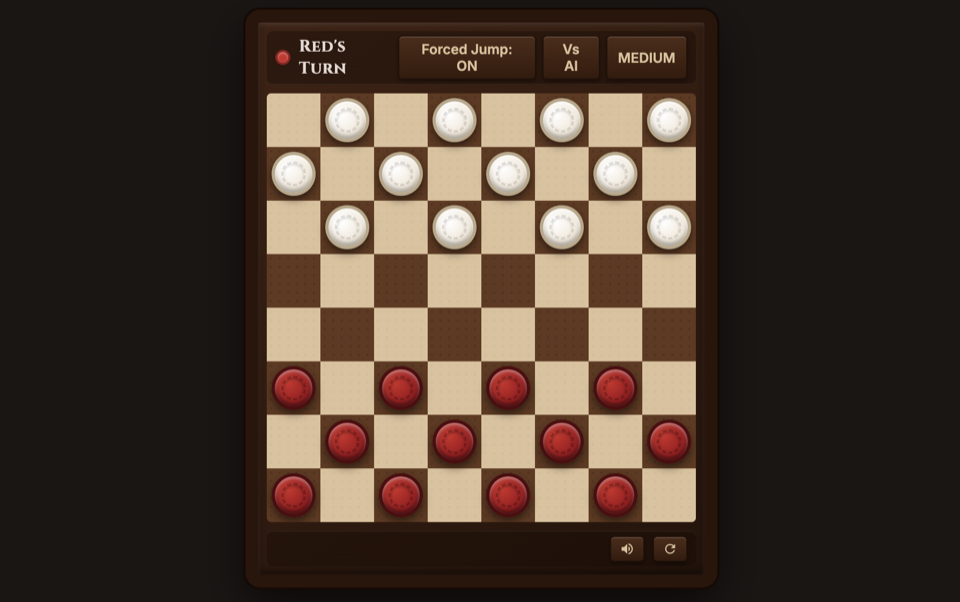
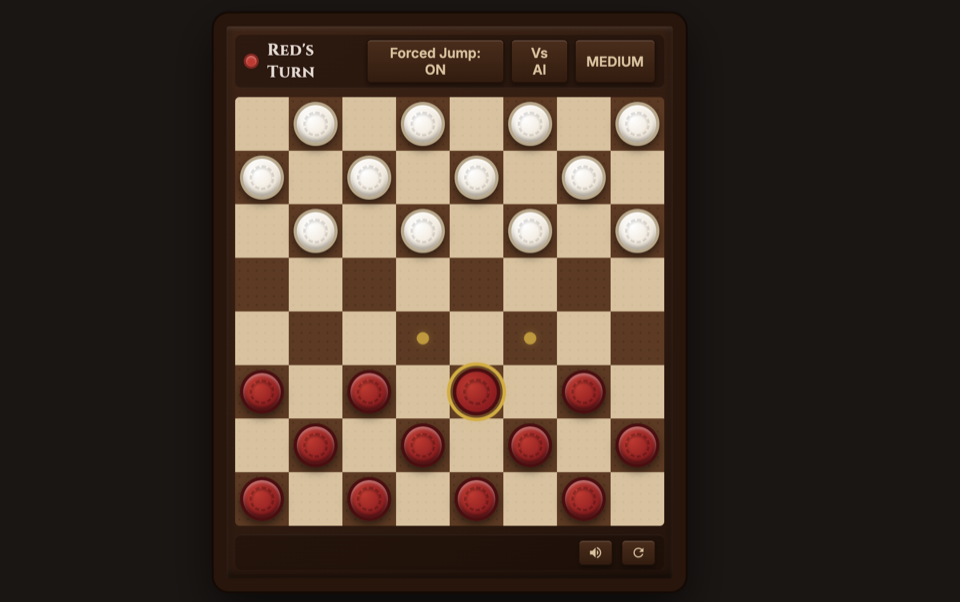

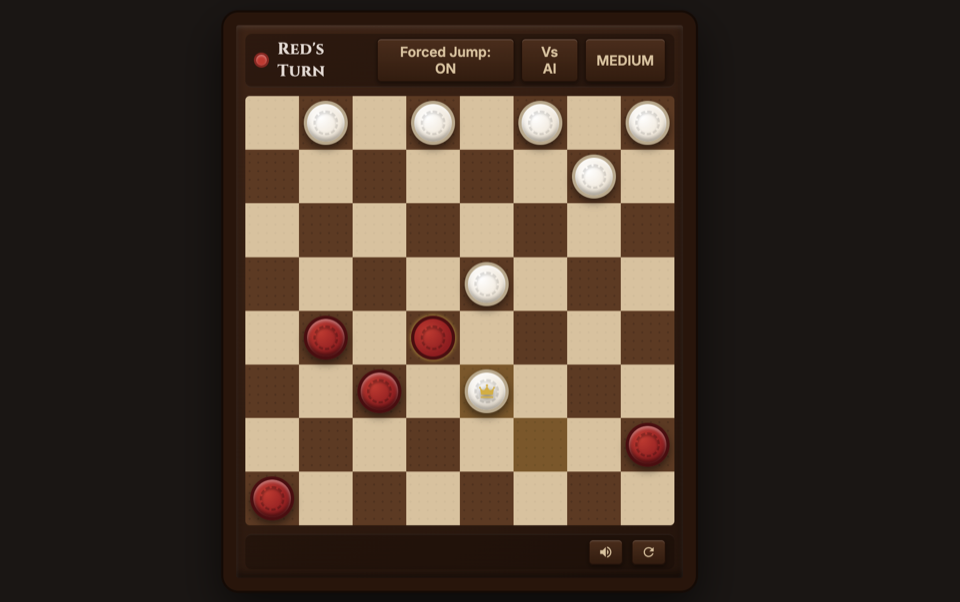
How to Play
Select Game Mode
Choose between 1-Player mode against the computer AI (Easy, Medium, or Hard) or 2-Player mode for local pass-and-play.
Move Diagonally
Click or drag a red piece to move it forward onto an adjacent empty dark square.
Execute Jumps
Jump over opposing pieces diagonally into empty spaces behind them to capture and remove them. If another jump is immediately available, continue the chain.
Promote to King
Advance a piece to the enemy back row to crown it a King. Kings can move and capture both forward and backward to seal victory.
Control the central squares
Position your pieces toward the middle of the board to maximize your movement choices and restrict your opponent's mobility.
Protect your back row
Avoid moving your back-row pieces prematurely, as keeping them anchored prevents your opponent from easily crowning early kings.
Set up forced double jumps
Sacrifice a single piece to force your opponent into a capture that opens up a multi-jump sequence for your own pieces.
Checkers Master Strategy Handbook
Welcome to the definitive strategy manual for Checkers on The Game Cove. Master diagonal positioning, jump captures, king promotion, and tactical sacrifices to defeat both AI opponents and human rivals.
1. Origins and Historical Heritage of Checkers
Checkers stands as one of the oldest and most widely played board games in human civilization, tracing its earliest roots back to ancient Mesopotamia. Archaeologists discovered early predecessors of the game in the ancient city of Ur, dating back over four thousand years.
The modern framework of Draughts emerged in twelfth-century France when players combined the grid layout of Alquerque with the movement rules of chess. This synthesis transformed a simple movement race into a rich tactical board game that quickly spread across Europe.
In 1994, computer scientists achieved a historic milestone by solving the game using automated computational proofs. Mathematical calculations proved that perfect play by both sides always leads to a draw under standard rules.
The digital era has preserved these traditional rules while introducing intelligent AI training partners to modern players. Today, Checkers remains a favorite mental sport enjoyed by millions of competitive players worldwide.
2. Board Geometry and Movement Mechanics
Understanding the physical layout of the grid is essential for developing a sound positional strategy across all stages of play. Checkers is played strictly on the thirty-two dark squares of the standard sixty-four cell board.
Each player controls twelve colored tokens that begin positioned on the three closest dark rows. Red moves first, advancing single pieces diagonally forward one square at a time onto adjacent empty dark cells.
Navigating these diagonal lanes effectively prevents your pieces from becoming isolated or trapped along vulnerable board edges. Maintaining mutual support between adjacent tokens forms the core foundation of a strong defense.
When an opposing piece sits on an adjacent diagonal cell with an open square behind it, you must leap over it to capture. Under standard tournament regulations, jump captures are mandatory whenever they appear on the board.
3. Tactical Principles and Positional Control
Controlling the central dark squares allows your pieces to command multiple diagonal paths simultaneously. Pieces forced to the side edges lose half of their mobility and struggle to influence action on the opposite flank.
Maintaining a solid defensive row along your starting baseline prevents your opponent from easily crowning early kings. Advancing pieces in mutually supporting pairs ensures that every forward step is protected by a trailing teammate.
Chain captures allow skilled competitors to eliminate multiple enemy tokens during a single turn. Always analyze the board for multi-jump opportunities before committing to a single-square movement.
Keeping your back-row pieces anchored as long as possible deprives your opponent of easy promotion avenues. Patience during the opening phase creates solid strategic structures for late-game attacks.
4. Advanced Sacrifices and King Traps
Intentionally sacrificing a piece is often the fastest way to break through a stubborn enemy formation. By forcing your opponent into a mandatory capture, you can steer their token onto a disadvantageous square.
Reaching the farthest enemy row immediately promotes a single piece into a crowned King. Kings possess the critical ability to move and capture both forward and backward across the grid.
During the endgame phase, active kings are essential for hunting down remaining enemy pieces and controlling key diagonals. Use your mobility advantage to corner solitary opponent tokens against the board borders to force a win.
Setting up double-jump traps rewards careful calculation and long-term planning. Forced capture mechanics turn defensive sacrifices into decisive counter-attacks when executed at the right moment.
5. Key Terminology and Definitions
The mathematical turn count advantage that allows a player to force their opponent into surrendering key board space. Controlling the opposition ensures that your rival must step into vulnerable diagonal lanes during endgame maneuvers.
The elevation of a piece that successfully reaches the farthest row on the opponent side of the board. Crowned kings gain the powerful ability to move and capture both forward and backward.
The mandatory rule requiring a player to execute a jump capture whenever one is available on the board. Failure to spot a jump is prohibited under official draughts regulations.
The classic baseline piece formation that anchors key back-row dark squares to block incoming opponent tokens. Maintaining a bridge prevents opposing single pieces from easily achieving early king promotion.
The corner dark squares located at the extreme ends of a player's starting baseline. Pieces trapped in a doghole suffer from severely restricted mobility and defensive vulnerability.
The deliberate offering of a piece to force an opponent capture that opens up a superior tactical line. Sacrifices are frequently used to set up multi-jump counter-attacks or secure king promotion.